Since I was little, I always dreamed of working with the giraffe. Just like most zookeepers, I was lucky enough to interact with these magnificent animals during experiences at zoos and watch them run across the savannah out in Africa. It’s hard not to fall in love with them. There’s something so awe-inspiring about being in their presence; from the way they look at you with those big, beautiful eyes to how they strut around, watching over the landscape. It has been a dream come true to care for them as a zookeeper at Wingham Wildlife Park and I want to share a glimpse into what working with the tallest species on our planet entails. I can tell you, it’s definitely a tall order indeed (pun intended).
Background
If the giraffes at Wingham Wildlife Park are to have the best welfare possible, it’s important that we learn about each species’ adaptations, anatomy and behaviour so we can meet all of their care needs. When it comes to giraffes, there is a lot to know.
There are four different species of giraffes, all with their own subspecies and ecotypes. At Wingham, we have Rothschild’s Giraffe (Giraffa camelopardalis rothschildi). They are a subspecies of the Northern giraffe species and a Nubian ecotype; growing close to 20 feet tall and weighing in at over 1,200kgs.
Rothschild’s giraffes are native to the grasslands, savannas and open woodland of Kenya, Uganda and southern Sudan; with their population ranging between 1,400 – 1,600 individuals. Being browsers, they primarily eat the leaves, branches, bark, shoots of trees and shrubs, with their favourite being the thorny Acacia tree.
Giraffes are incredibly well adapted to their environment and have a multitude of superpowers that help them dominate their niche within this ecosystem. Not only are they the tallest of all animals on our planet, but also have other impressive adaptations, such as their 58cm long, prehensile tongue, thick lips and specialised digestive tract. To save you reading a ten-page blog on giraffe adaptations, definitely check our 3pm giraffe talk if you want to learn more about their adaptations and biology!
At Wingham, we have a tower of four male giraffe: Ruedi, Robin, George and Henry. Our boys range in age from 3 to 8 years old and form a bachelor herd. Each of them has their own distinguishing characteristics, personalities and preferences that us keepers learn in order to provide them with the best care. It’s an absolute pleasure working with them all. They’re all so unique and amazing individuals, that teach us so much every single day – its an absolute pleasure working with them all!

Husbandry
Husbandry refers to everything related to the care of animals; from cleaning their enclosures, providing enrichment and preparing their diets etc. When it comes to cleaning our giraffe enclosure, it’s a time-consuming, daily job. Our routine always includes scraping and sweeping the floors of their bedrooms and communal space, poo-picking their outside area, cleaning and refilling their water troughs and hay racks, putting fresh browse up on the winches and mucking out their straw bed. Usually, these jobs combined take keepers around 4-5 hours a day and don’t include the time needed to create and distribute enrichment, animal training sessions and feed the animals their diets throughout the day. Our animals’ health and wellbeing is reflected in our standards of care so it’s important that we ensure every job is done to the highest standard every single day. It’s no easy task but we take so much pride in our work and always aim to provide the best care possible.
Dietary Requirements
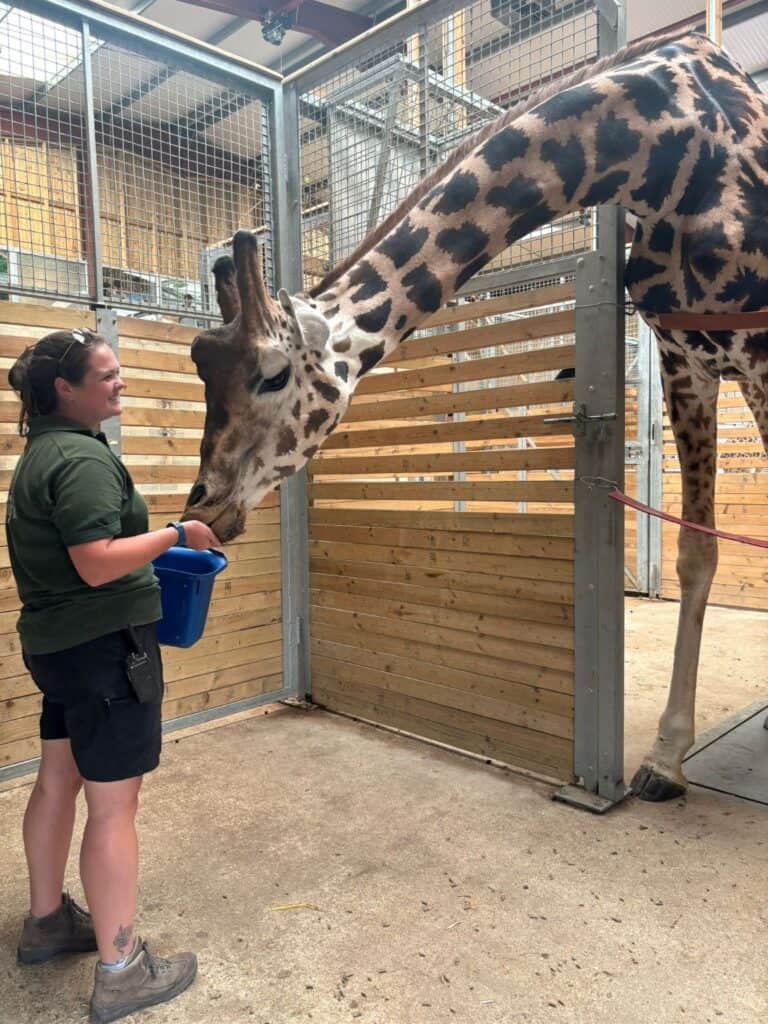
As I mentioned, giraffes have a unique digestive system, being ruminants they can eat for over 20 hours a day! This means they go through a LOT of food and it’s our job to have their meals prepared and ready to go.
We feed our giraffes a variety of food each day to ensure we’re providing them with the correct amount of essential nutrients they require. They start each day with buckets of specialised browser pellet, followed by lots of fresh browse. We are very lucky at Wingham to have 86 acres of woodland that our dedicated Maintenance Team sustainably cut down browse from several times a week. We have this stored in large water tanks that we can access throughout the day to ensure they always have fresh food to munch on; hanging it from winches and balconies to make it as natural as possible for our animals. We also spend the summer months silaging this browse in containers, ready for the colder seasons when browse is in short supply (see Head Keeper, Matt’s blog on Browse and Silage here).
The giraffes will have multiple buckets of browser pellet during the day to keep up with their large appetites, as well as other tasty snacks. There are also several hay racks scattered around their enclosure, that keepers fill with lucerne – a high protein and nutritional value hay that contains many vitamins and minerals. And we even add stinging nettles and thistles to the racks, which the animals really enjoy.
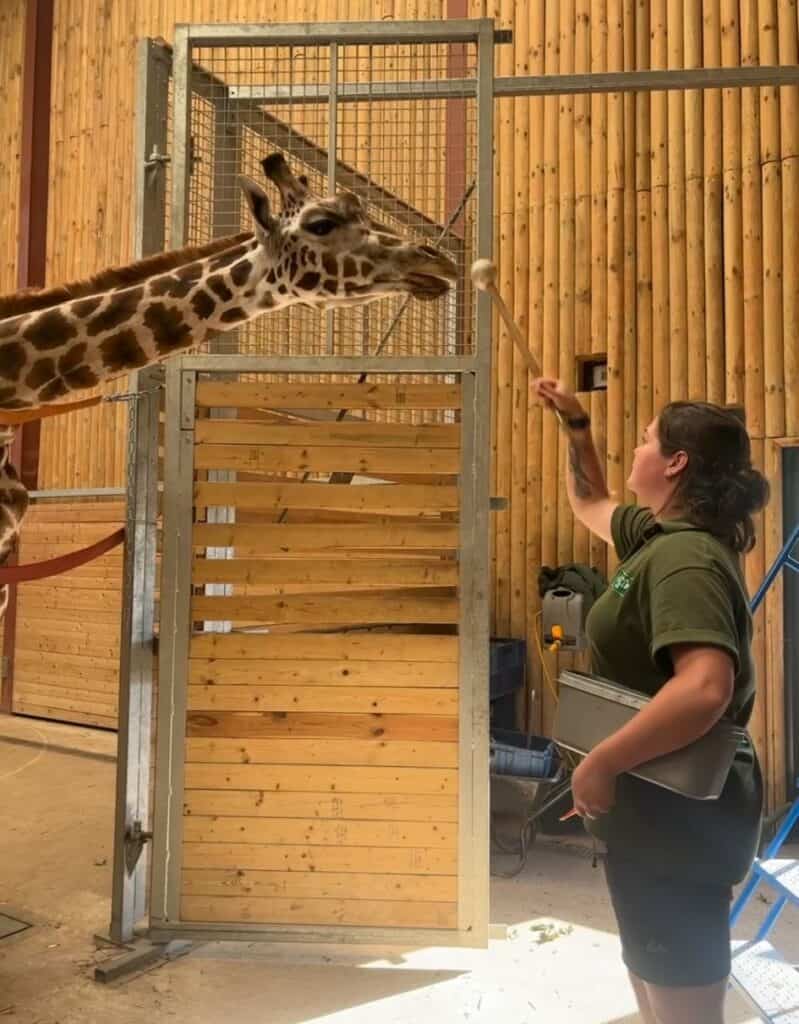
Lastly, on the menu for our giraffes, is carrots! We are careful to only give them a small amount per day, due to the high sugar content. But carrots serve more than just as a sugary treat. We use them as a reward during training sessions and during our animal experiences, as a way of telling the boys they’ve done a great job. You can learn more about that in the next section…
Training
Animal training is my favourite part of the job, especially with the giraffes. It’s an essential part of their care; allowing us to provide them with more hands-on procedures to be proactive in diagnosing any issues that may occur with their health, in a voluntary way.
Training for our giraffes can be anything from asking them to come over for a visual health check, target training, having them present their hooves on a block, or lowering their heads down so we can train behaviours for injections or blood draws etc. Keepers build their relationships with each animal; learning more about their personalities in a way that can help us better develop their care on an individual basis, as well as form trust between parties. Without forming these relationships and building trust with our animals, we wouldn’t be able to do this important work with them, so it’s definitely the most essential part of training.
This is where carrots come into play. They act as a positive reinforcer (fancy word for ‘treat’), letting our animals know they’ve exhibited a behaviour correctly and increasing the likelihood of them repeating this behaviour when we ask in future. Our animals then associate these sessions as a positive experience, meaning that any possible veterinary procedures go smoothly and are a lot safer for both the giraffes and ourselves.
Enrichment
Another essential part of our day is ensuring the giraffes are stimulated both mentally and physically. Environmental enrichment is our secret weapon; providing a variety of novelty items and toys for the animals that encourage them to exhibit natural behaviours, explore their environment, interact with different stimuli and keep them engaged by using their mind and body.
For the giraffes, we also use food-based enrichment such as puzzle feeders with carrots, feeder balls filled with browse, silage or lucerne and even firehose that we can sneak tasty treats inside of. We make sure to vary the enrichment each day, preventing boredom and presenting our animals with new and exciting learning opportunities and rewarding experiences.
I hope you enjoyed learning more about what working with giraffes at Wingham Wildlife Park entails and we look forward to welcoming you. Make sure to say ‘hi’ to the boys on your next visit!

By Sophie, Mammals Keeper