In this blog I will be discussing what goes into training big cats for voluntary blood draws, a procedure in which the cat is trained to allow a sample of blood to be taken, usually from the tail, whilst fully conscious. These samples are taken to check for a variety of markers that indicate the health of our cats.
Using this method we can avoid having to anesthetize the animal, which can be a stressful procedure.
In this blog I am going to talk about enclosure usage, training plans and how we go about getting a big cat ready for this procedure.
Enclosure Usage
Firstly, I have a good look around the enclosure to work out where is the best place to do the procedure, if you are taking the sample from the tail, can you get the tail under the mesh or through the mesh and where can you get the cat to line up sideways to the mesh.
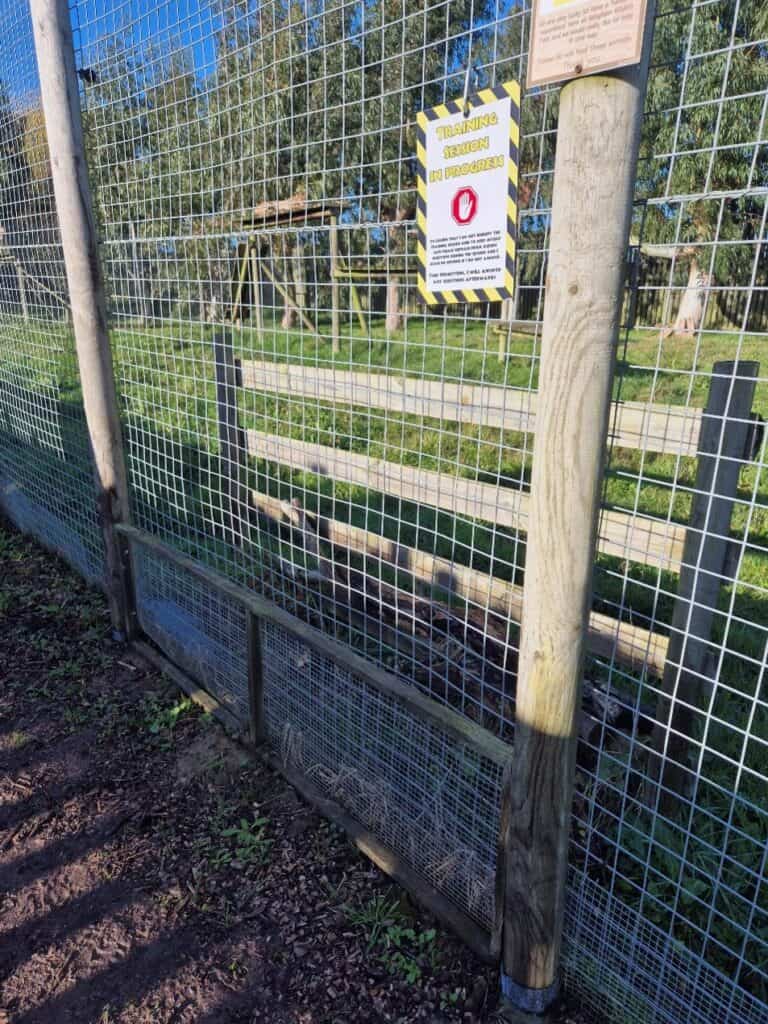
Most cats will face you at the mesh so to get the cat to line up sideways I either use a corner of the enclosure, a shelf, or build a training barrier.
A corner of the enclosure will allow one person to feed the cat while the other keeper has access to the tail.
A training barrier will allow you to get the cat side-on, you will need to make it so the cat cannot turn around inside it and that they are comfortable but flush to the mesh to give the best access to the tail.
These images show our cheetah training barrier with removeable panel to access the tail and male Cheetah, Colonel Tom, using the training barrier.
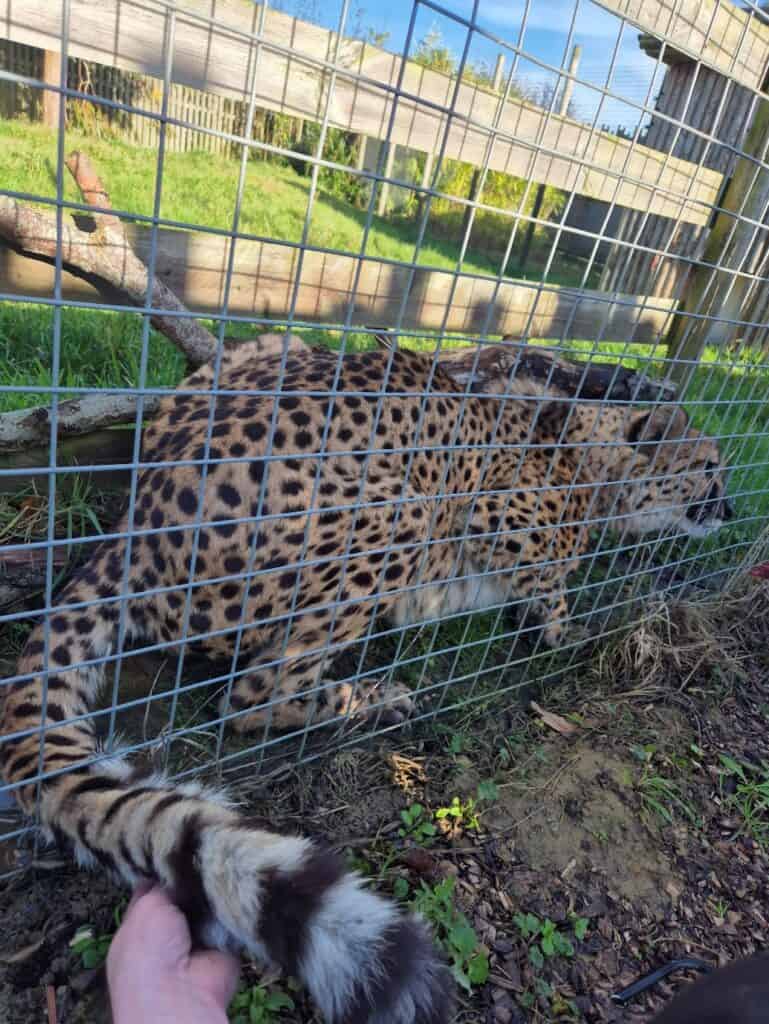
Tunnels are a fantastic resource for a trainer and give a great space to line the cat up and access from both sides.
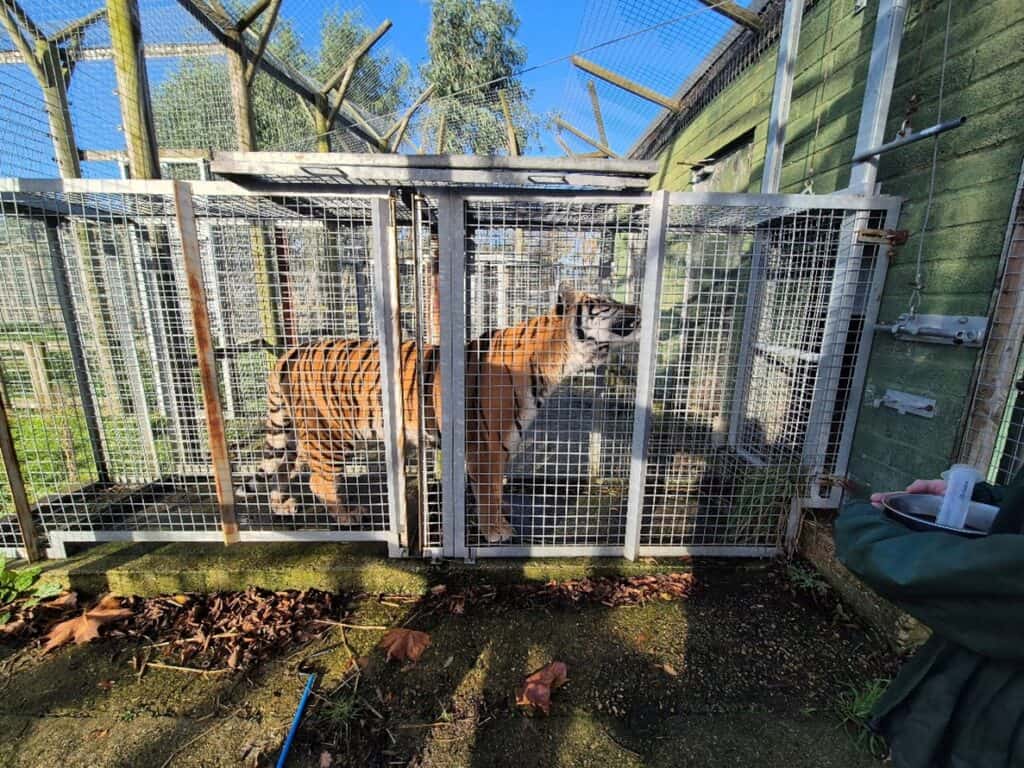
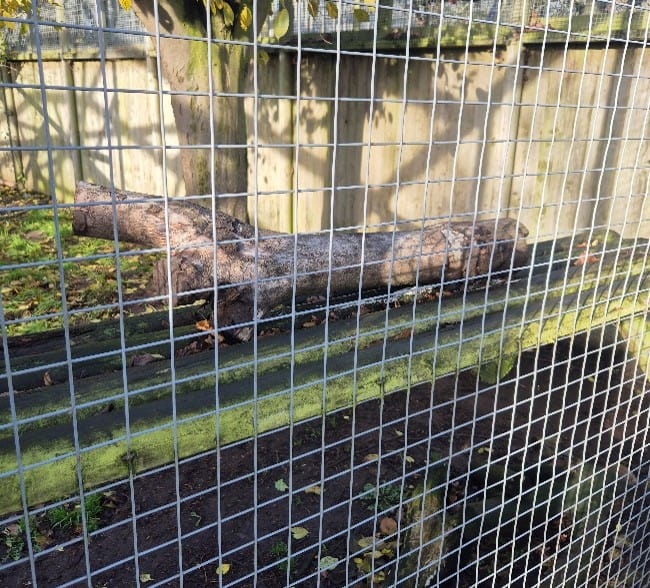
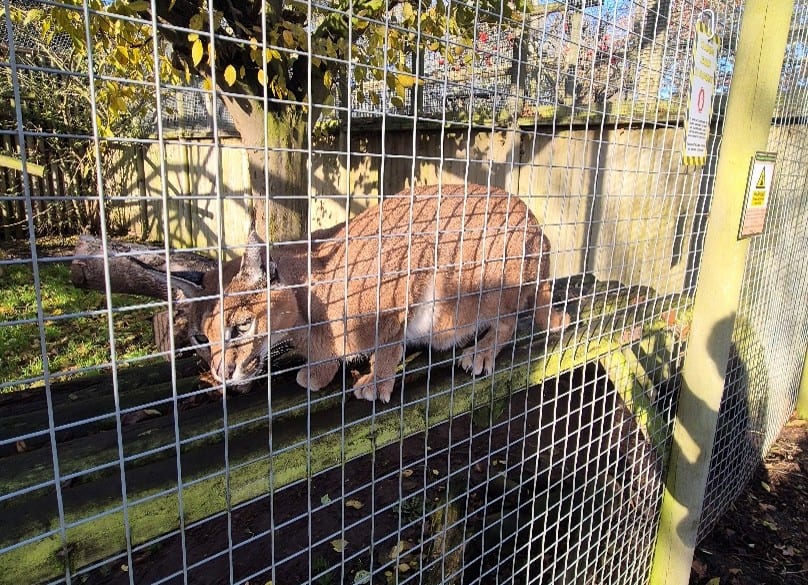
A shelf can also work if they are at a practical height. If the shelf is quite large so the cat can still face you and turn easily, then I make use of a trusty log! A well-selected, heavy log placed on the shelf can give you a temporary barrier to get the cat to practice laying side-on to the mesh. I have used this for our caracal, Maya.
Motivation and Rewards
I then move onto thinking about the cat and what best motivates them. This normally always involves food, food is a trainers best friend, but it’s finding the perfect combination of what will get the cats attention, but will also keep them calm and for a long duration. Some cats can be “food aggressive” so rewarding the cat only when they are calm may be the first step.
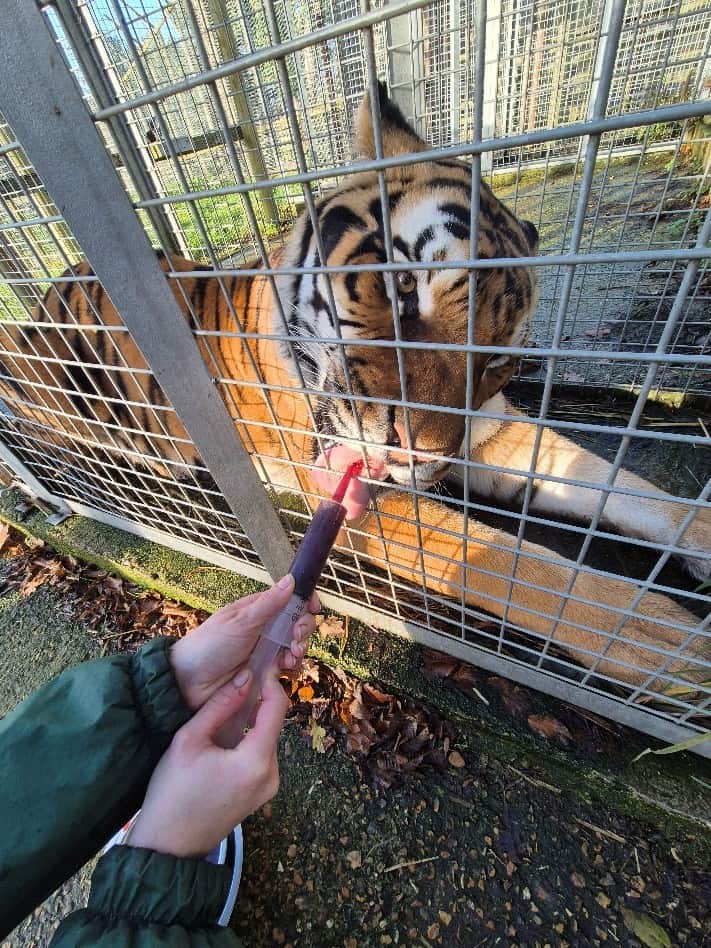
I have found that what works for some cats doesn’t for others, for example Troy will lay very still for a long period using blood in a large syringe. He loves this reward and drinking it keeps him occupied.
However, I have tried this with the jaguars and they just look at the syringe with confusion and do not accept it as a reward.
The jaguars do much better with small chunks of meat drip-fed throughout the procedure. The rewards are still marked with bridge* for any significant action, such as touching the tail, moving the tail and holding etc.
Image: Troy enjoying a blood syringe.
*a bridge is a signal (usually auditory like a whistle or clicker to tell the cat that the behaviour was good and a precursor to the reward.
What Time and How Often?
Motivation can also vary depending on the time of day. So choosing the time wisely is also an important factor to get the most out of your sessions.
I think about when the animal is naturally most active, are the nocturnal? Is there a time when they normally get fed in which they become more active, can this feed be substituted for a training session?
On the other hand, for some cats, any time is a good time! Duke and Tora are always very active and keen to come over, this is a great benefit as you can fit the session in when you can. Doing the sessions at differing times during the day can be more enriching.
When it comes to how often, this depends on your time-frame and the temperament of your cat.
Each individual needs their own training plan, but generally for very shy animals I build them a routine that is the same everyday for them to gradually become used to, at the same time of day.
For confident animals you may be able to train less often and at differing times of day.
How Many People Do You Need?
It’s good to have a plan in mind about how many people will need to be involved in the procedure. For these I normally have one person at the feeding end and one in control of the tail and bridging and also the vet for the blood draw. Some animals will not be bothered by how many people are there but others will mind a lot! So, depending on the animal, I will prepare them by doing the sessions with at least 2 people, this avoids having setbacks later on in training when including more people offends the cat!
Desensitising: What Will My Cat Need to Get Used to?
Most of the training process is not natural behaviour or part of their normal day, but some things in particular can be quite a milestone to overcome. I think through everything the cat may encounter for the procedure and what might need to be introduced into the training plan. Some examples of this is strange smells. The solution used by the vet to disinfect the area of the tail can be quite potent and alarming to a cat, this is perfectly understandable! So sometimes, I have needed to have a cotton ball with the solution on and just have it in their vicinity while I train. This desensitises them to it so it becomes a less alarming smell and to be expected.

I think of any possible object/smell/noise that the cat won’t be familiar with and use it during normal training sessions.
Shaping Behaviour
Once all of those factors are thought about then comes the training plan!
This is the step-by-step list of behaviours we are looking to see, each step building up to the final behaviour.
Breaking the behaviour down into small steps helps to work though and build a strong behaviour. The following is a rough example:
- Does the cat come over to the keeper?
- Introduce to the training barrier.
- Cat will come into the training barrier.
- Cat will lay down in the training barrier.
- Cat will lay down in the training barrier for several minutes.
- Introduce tail hook (we use a hook to get the tail through/under the mesh), show hook and reward.
- Cat is comfortable with the tail hook.
- Touch cat tail with hook, bridge and reward for this, and repeat until the cat does not react to it (they do not look around nor move position/tail).
- Attempt to move the tail towards the mesh. Bridge and reward. Practice this and ensure the cat is comfortable and does not react before proceeding to the next step.
- Manoeuvre the tail out, bridge and reward. Practice this step.
- Once the tail is out, hold tail for a few minutes and give high reward/continuous reward (whichever works best for the cat).
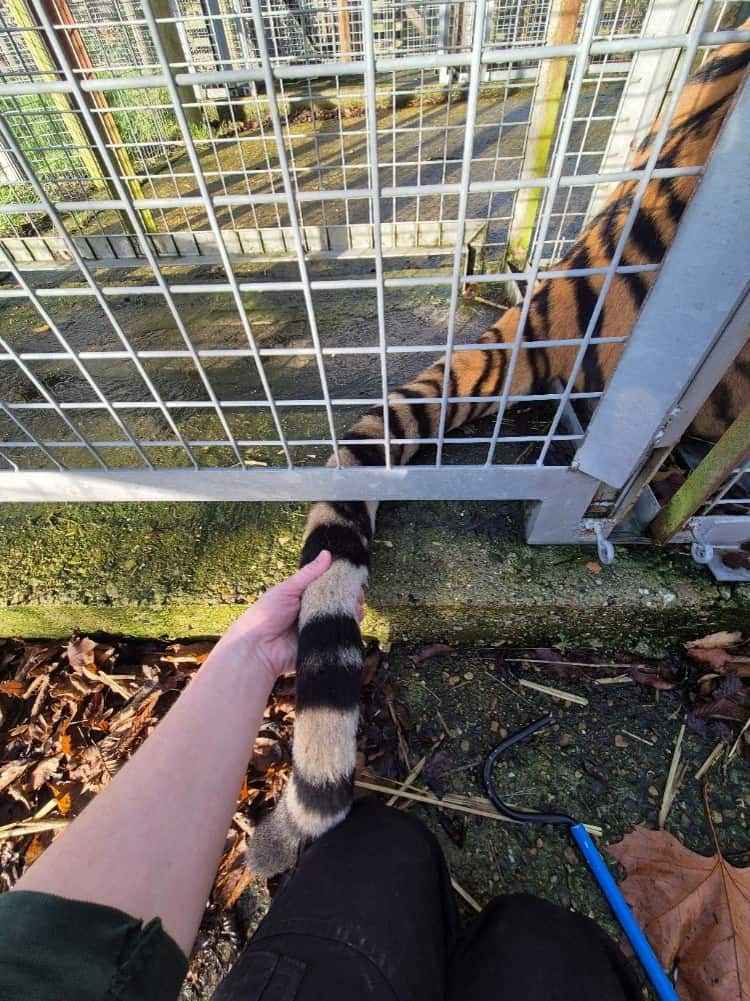
This gets the cat to the basic level, from then I work on introducing training needles, extended time with the tail and any extra stimuli I need to desensitize the cat to.
So a lot goes into this training but the outcome is something to be proud of and a huge accomplishment for any cat! Once they are trained we maintain it, should it need to be used again, and it’s a great way to give them attention and enrichment!
By Georgia, Head of Carnivores