A vital skill in looking after animals is being able to identity when they may be sick or injured and knowing how to treat this. One of the easiest ways to tell an unwell animal is knowing its behaviour.
Animals are incredibly good at hiding pain. So, by knowing what’s “normal” for your animal and what isn’t, can be a great indicator that something isn’t quite right. The same can be said for your pets at home. If little Rover suddenly doesn’t want the pedigree chum he usually wolfs down in seconds or Mr Tibbles has started cowering and hissing in a corner instead of purring on your lap, this might mean something has happened to make them unwell or hurt.
In many instances, after a few hours of monitoring, animals tend to right themselves. However, in some instances, you’re going to need some external help from your vets.
What do zoo vets do?
In zoos and wildlife parks, having a good, trustworthy veterinarian is crucial to animal health and welfare. Zoo vets have to have years of expert training to qualify. It’s not every day you may be tending to a tiger or a tamarin! Some vets are solely employed by the zoo. Whilst, others are domestic vets who also cater for a zoo when required.
So, what sort of things would you call the vets out for in a zoo? It may not be as glamorous as you think. A lot of a vets’ time is taken up by poo. They will take poo samples from every species in the park and check them regularly for worms, parasites and any abnormalities. They will also route through any unusual poo that appears from a potentially unwell animal.
As with your pets, you would get a vet to take a look at them if you were concerned about any injuries or if they were being particularly lethargic etc and it’s the same here. We just can’t always crate ours up and physically take them! Having said that, we do occasionally do just this. So, having some of our smaller animals trained and happy to go willingly into a crate is a big time saver. Plus, it’s a lot less stressful than having to run around and catch them with a net! Next time you’re in the vets waiting room, take a sneaky peak in the other crates, you might just spy a red panda or a lemur in one!
Recently on the primate section, we have had a few occasions in which we have needed the vet. So, I thought I would share these experiences with you now.
Recent vet call-outs
One of our chimps, Georgia, has been struggling with her movements recently due to reaching the grand old age of 46. She also suffered a fall from a beam in the garden a few weeks ago. It took her a few moments to get back up from said fall. So, the decision was made to sedate her so we could get a good look and a feel of what’s going on in her body.
This took several weeks of planning, getting her comfortable being shut in a bedroom by herself and happy for her keepers to inject her with a needle. As I mentioned previously, training animals in such ways can reduce stress levels. It makes for a much easier time than having to shoot them with a dart gun which increases stress and raises adrenaline levels (learn more about training here). Having said that and with all the planning in the world, sometimes things just sadly don’t work out.
When D-day came for Georgia, our keeper Jess was able to get half of the drugs into her via an injection. However, as it was a slightly different sensation to normal, Georgia caught on, moved away and would not trust Jess again in coming close enough. Georgia’s adrenaline levels raised so high that topping her up with extra drugs simply had no affect. So, we had to abandon and try again on another day.
Plan B
To avoid a repeat, Jeremy the vet used the dart gun straight away this time. However, Georgia being very clever, knew exactly what he was up to and stayed near the mesh. Therefore, this time, she was too close to be darted. As we waited for her to move, in true chimp fashion, she threw so much poo at the vet, there was a Jeremy shaped silhouette on the wall!! Soon enough though, Georgia fell asleep, and we were able to move her to the hospital room.
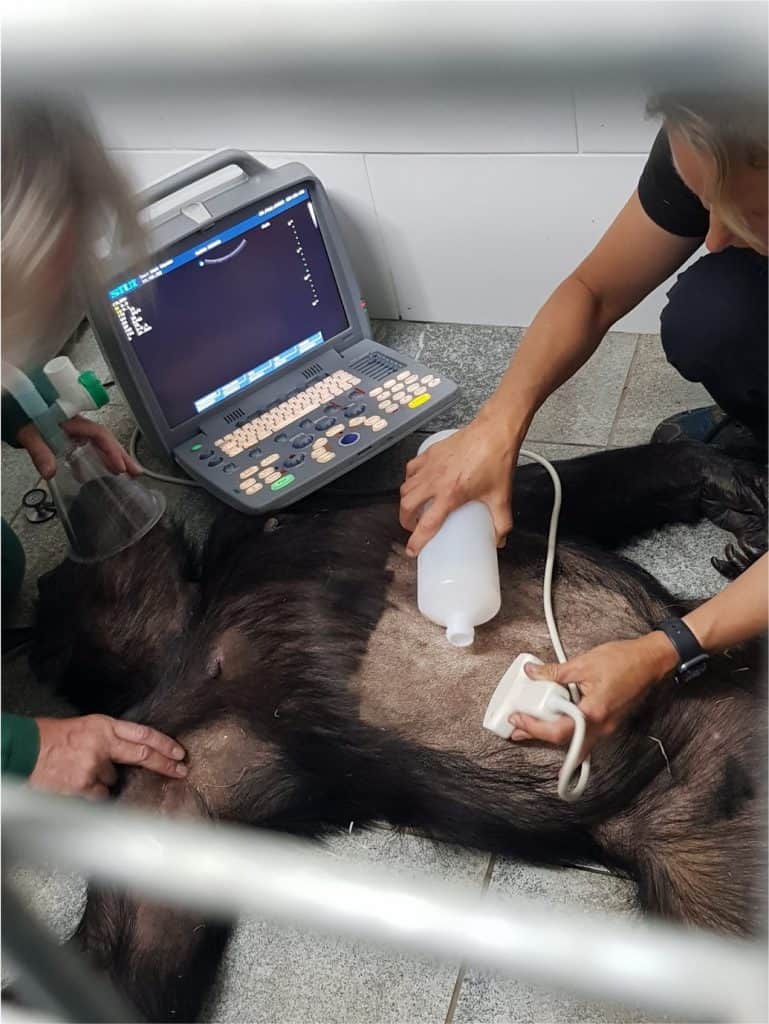
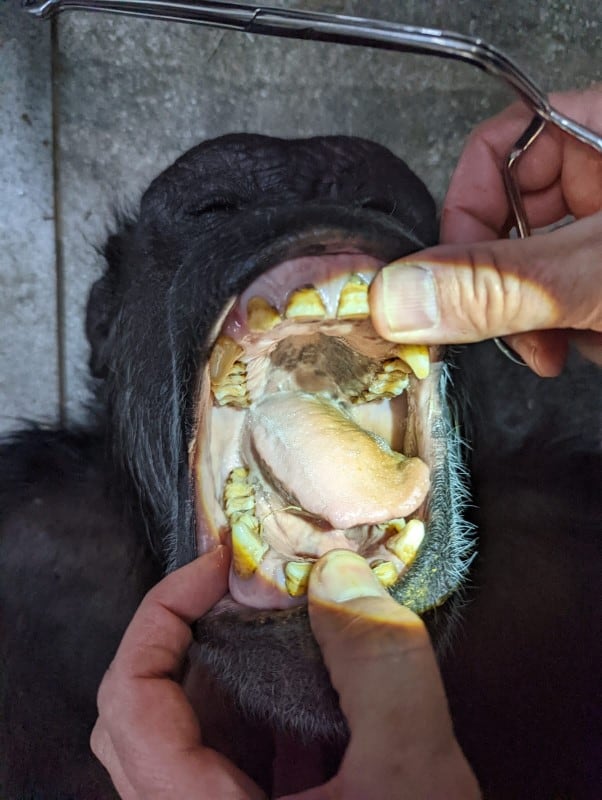
During her sedation, we were able to take blood samples, x-ray her joints, check inside her mouth and perform an ultrasound on her tummy. She was unconscious for less than an hour. She recovered quickly and was back with the group before dinner time. The findings were what we suspected already; she has severe arthritis in various joints. Because we were able to examine her, we can now treat her with regular pain killers. We can also look at adapting her environment a little to become more user friendly for the old girl.
Night Monkeys
On a slightly smaller scale, we’ve also sedated and operated on several night monkeys in the past few weeks. Keepers caught up all the females to give a contraceptive implant to halt any breeding for now.
Once sedated, the night monkeys were given a microchip. this was done via a needle into the back of the neck, the same as your dog or cat. Plus, they were given the implant into their freshly shaved inner thigh via another needle.
We were also able to take blood samples from each monkey. These are sent to a lab in Scotland to be part of the EAZA Biobank for research. A reversal drug was given, and all recovered quickly in their crates before being put back into the enclosures with the boys.