Did you know that 2nd July is porcupine appreciation day. What a perfect opportunity to talk about one of the most misunderstood creatures here at Wingham, the African crested porcupine. If you aren’t already in love, hopefully you will be by the end of this blog.
Say Hello to Our Trio
Here at the park, we house three African crested porcupines. One male and two females. Named by our lovely head keeper Matt many moons ago: Paul, Paula, and Pauline. This is a family unit consisting of mum, dad and daughter. Paul and Paula are both the grand age of 18 and will both be 19 this year. Whereas Pauline turned 9 years old earlier on in the year.
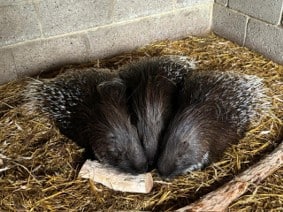
We are extremely lucky to have had them for as long as we have. Paul is the smallest of the porcupines and is browner in colour. The girls are a lot harder to tell apart, but Paula has a slight white mark on her nose if you look close enough. Being younger, Pauline is also the more playful, confident and inquisitive in the group. You will find all our porcupines between our warty pig enclosure and our brown-nosed coati enclosure up near the lake.
Life in the Wild
African crested porcupines are the largest of the porcupine species. They’re nocturnal and you will typically find them across North and sub-Saharan Africa. They thrive in a wide range of habitats, from savannas and forests to rocky hillsides and deserts. They’re excellent diggers and typically live in burrows underground that they have dug but will sometimes take over burrows from other animals. These are great safe spaces to hide from predators and to protect them from the heat during the day. They will then venture out in the evening when it’s much cooler.
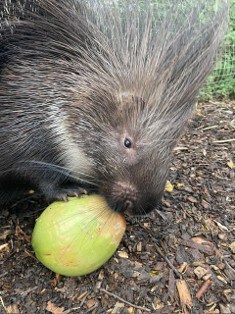
There’s believed to be around 30 different species of porcupine ranging in all different shapes and sizes. However, there’s something that all these species have in common which is being part of the rodent family. Rodents have incisor teeth which grow constantly throughout their lifetime. To help keep on top of their dental care, they would naturally chew on logs and browse in the wild. They have even been seen chewing on bones which helps to maintain strong teeth and gain essential minerals like calcium. Being a herbivore they would also eat roots, tubers, fallen fruit, bulbs and crops.
Tiny but Tough
Being monogamous, they will usually stay with the same partner for life. Both male and females will look after their young which are called porcupettes. They typically will have 1-2 babies per litter after a 112 day gestation period but in rare cases, up to 4 have been recorded.
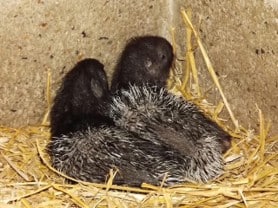
You’re probably thinking, how does a porcupine give birth to their spikey offspring? but they’re in fact born with soft quills that harden after birth. They enter the world with their eyes open and can walk straight away. We’ve been very lucky to house many babies in the past who have now gone off to other places in the UK and Europe to start their own families.
Those Famous Quills
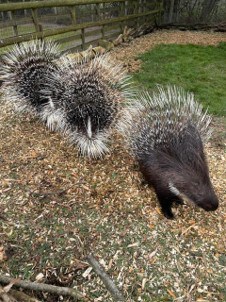
The most iconic feature of the porcupine of course are their quills. They can grow to a whopping 50cm and vary in thickness. You will normally find smaller and thinner quills at the top of their body near their head and very thick quills near their more vulnerable areas at the back of the body. Unlike what some of you may think, they cannot shoot their quills, otherwise us keepers would be looking after the porcupines with a full set of armour on and a shield every day. Instead, when threatened, they raise their quills to appear larger and charge backwards to impale a predator.
If an African crested porcupine is threatened by a predator and the quills make contact, the quills are easily detached so they can quickly be released and will regrow over time, like human hair. The quills of this species are not barbed like their South American cousins. They’re believed to have around 30,000 quills altogether. I wonder who drew the short straw of having to count those.
Why They Need our Help
African crested porcupines are classed as a least concern species on the IUCN red list website which is great news. However, they still need our help. Porcupines are fantastic ecosystem engineers and play an important role by turning over soil to help with plant growth and to disperse seeds through their feeding habits. Many come into conflict with humans due to crop feeding as well as habitat loss and being hunted for their meat and quills. The quills have many uses, including traditional medicine, fishing lures and ornaments.
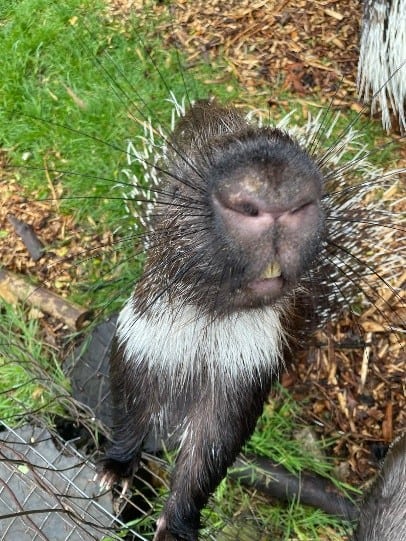
On your next visit, make sure you say hello to our “prickle” (this is what a group of porcupines is called). You can even book one of our Keeper for the Day experiences where you can give Paul, Paula, and Pauline some enrichment.
By Meg, Head of Mammals