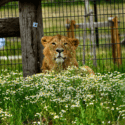
Asiatic Lion Natural History
Size
The Asiatic lion is smaller than it’s African cousin but still weighs an incredible 190kg on average with males being larger than females.
Habitat and Distribution
This species once roamed across northern Africa, the Middle East and Asia. However, Asiatic lions are now found in only one location on Earth: India’s Gir Forest.
Age
The lifespan of an Asiatic lion can be up to 20 years in captivity but would be considerably less in the wild.
Diet
Like all big cats, Asiatic lions are obligate carnivores so their diet consists entirely of meat. In the wild they hunt buffalo, birds, antelope, deer, monkeys and boar.
Groups and Breeding
These lions live in prides with several females living with one adult male. Females tend to stay together for life with male cubs leaving to form their own prides and coalitions at around two years of age.
Females usually have a litter every couple of years to between 1-4 cubs.
Threats
The Asiatic lion is classified as endangered with less than 600 individuals remaining in the wild. Shrinking habitats, climate change and hunting have all had a huge impact on this species and their population in the wild is declining.
Wingham Wildlife Park are part of the European Endangered Species Breeding Programme (EEP) which is responsible for managing a healthy, genetically diverse population across European zoos to protect the future of the species for generations to come if wild numbers continue to decline.
Interesting Facts
Their retractable claws are almost 4cm in length.
The Asiatic lions During Your Day Out in Kent
At Wingham Wildlife Park the three Asiatic lions can be seen at the Big Cat House which was constructed as a part of our huge expansion project.
We welcomed three young brothers, Theo, Rakesh and Thor, in May 2026 from from FOTA Wildlife Park where the boys had lived since their birth in June 2024
This area is also has tiger enclosures where Duke and Tora can be seen too.
The more you know…
Want to know more about this animal? Check out our keeper blogs about them here.