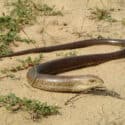
European Glass Lizard/Legless Lizard
Size
The European legless lizard is the largest legless lizard species in the world, typically reaching a total adult length of 3 to 4 feet (90 to 120cm), with exceptional specimens measuring up to 4.5 feet (135cm). Across all species, the tail usually makes up to half or two-thirds of the total body length. Adults typically weigh between 300g and 680g (0.7 to 1.5 lbs)
Habitat and Distribution
Legless lizards primarily inhabit loose, sandy soils, grasslands and woodland edges. They range from the Balkan Peninsula in Southeastern Europe through the Middle East, Central Asia, and the Caucasus.
Age
In the wild, they can live between 10 – 30 years, but in captivity, they can live up to 50 years.
Diet
Legless lizards are primarily carnivorous and insectivorous. In the wild and in captivity, their diet mainly consists of insects, spiders, snails, earthworms and occasional small mammals or bird eggs. They are also known to eat small lizards and snakes in certain species
Groups and Breeding
Legless lizards are generally solitary and territorial animals. Rather than living in complex social structures, they typically interact only during the breeding season. During the breeding season, males seek out females and may bite the back of the female during courtship, intertwining their bodies.
Threats
The IUCN have listed this species as Least Concern, but legless lizards still face severe threats in the wild, primarily driven by habitat loss, invasive predators and climate change.
Interesting Facts
Legless lizards are not snakes because they evolved from totally different ancestors. While they both adapted to slither through environments where legs were a hindrance, legless lizards retained the anatomical features of regular lizards, including the ability to blink, visible ear openings, and the ability to drop their tails to escape predators.
During Your Day Out in Kent
Here at Wingham Wildlife Park, we have three of these lizards, unfortunately they are currently off show in vivarium’s in the reptile kitchen.